
In two days, I will pack my most important possessions into my parents’ car and drive, rather anticlimactically, approximately two miles down the road, at which point I will unload said possessions, kiss my parents and sister goodbye, and begin a new life as a university student. With my records, books, and Macbook in tow, I will move into a residential college with a couple hundred other students and remain there, more or less, for the next four years. Despite the fact that my future and current homes share a zip code, I nonetheless feel what I imagine are the typical emotions for an eighteen-year-old approaching college life. I am nervous, excited, and more than a little anxious. I can practically taste the relative freedom that, according to movies and my older friends’ Facebook photo albums, college students experience all the time. I want to be intellectually challenged and meet girls who also like reading Sartre and learn about bleak philosophical concepts that will realistically not help my prospects of ‘making a living’ in the future, despite what my great aunt says about an Ivy League education in the humanities still being ‘worth the investment.’
But beneath this adolescent excitement, there lies a troubling question. Since I chose not to leave New Haven for college, will I ever be able to truly escape? Should I even want to? So much of the music of my youth has praised the notion of transcending one’s hometown for bigger and better things, and although my existence here has never been particularly bleak, I fear that I may have already passed up my Born To Run moment. And my “This Year” moment. And possibly my The Monitor moment. And, to a slightly more embarrassing extent, my “Read My Mind” by The Killers moment.
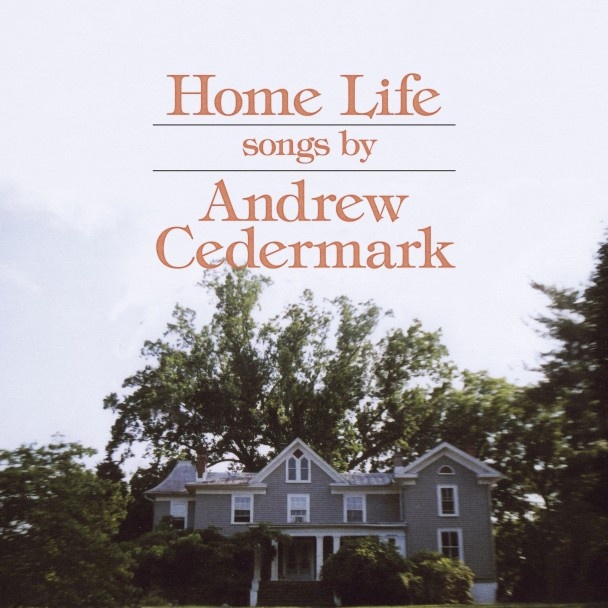
As I approach the college milestone and ponder the consequences of the choices I made during this process, Andrew Cedermark’s latest LP, Home Life, is stirring both my excitement and my anxieties for the next chapter in my life. I was first introduced to this New Jersey-hailing songwriter from his work as a member of Titus Andronicus before they parted ways after The Airing of Grievances, and as the frontman of the proto-Titus act The Library of Congress, whose 2004 record Selected Writings On The Human Condition is an oft-overlooked gem of the then-nascent wave of New Jersey indie rock that exists today. Cedermark left Titus Andronicus apparently due to the rigors of heavy touring, an understandable reason that nevertheless feels essential to understanding the nature of Home Life, his second solo record.
This is an album that deals with the intense conflation of feelings that many creative 27-year-olds probably have about the notion of a domestic existence. Cedermark appears to feel at once too young to settle down and too old to break out, confined by his own decisions but nonetheless empowered by the fact that he made them himself. There are undercurrents of transcendentalism in this self-imposed solitude, but they are often buckled by bleak overtones of loneliness. The album’s first track, a minor-key interpretation of Bill Withers’ “Lean On Me,” captures the essence of both in one deliberately muttered line: “I tried to be kind for wanting to be loved / but it wasn’t long till I had but a beer and nobody to lean on.” When Cedermark subsequently slumps into the original song’s familiar chorus, he seems to be making more of a plea than an offer.
On a musical level, Home Life mines the aesthetic ore of what I assume to be Cedermark’s youth. There are gritty Neil Young guitars (on “Tiller of Lawn” and “Train Window Man”), improvised alt-country moans that recall Uncle Tupelo, and the inescapable shadow of Springsteen, the patron saint of melancholic, guitar-strumming New Jerseyites. “Never forget to give due praise to the old masters,” Cedermark reminds himself on the blues harp-laden “Come Back.” Yet Home Life also bares the influence of more modern acts such as Silver Jews and Pavement; it’s no coincidence that Cedermark lived in Dave Berman and Stephen Malkmus’ familiar haunt of Charlottesville, VA as a college student. Album highlight “At Home,” for example, is straight-up 90’s power-pop, deceptively catchy, half-mumbled vocals and all.
Cedermark’s nods to the music of his childhood correlate with the album’s retrospective lyrical tone, but Home Life is not an entirely nostalgic album. Throughout these ten tracks, it seems that he is worried mostly about the future. Towards the end of “Train Window Man,” for example, Cedermark expresses these fears in a simple yet eloquent verse: “I don’t know where I am, but it feels like I’m getting there / and when I get there again, I just hope I recognize it.” Like Cedermark, I too am at a crucial point in my life, unable to completely reconcile the notion of what ‘home’ means to me in this confusing, turbulent context.
Although I will remain here in New Haven for the next four years, the perspective through which I view this uniquely familiar place is bound to change drastically. At this point, all I can do is hope that, whenever I approach the next turning point in life, I too will recognize the timeless importance of where I’m from.
Home Life is out now via Underwater Peoples.