
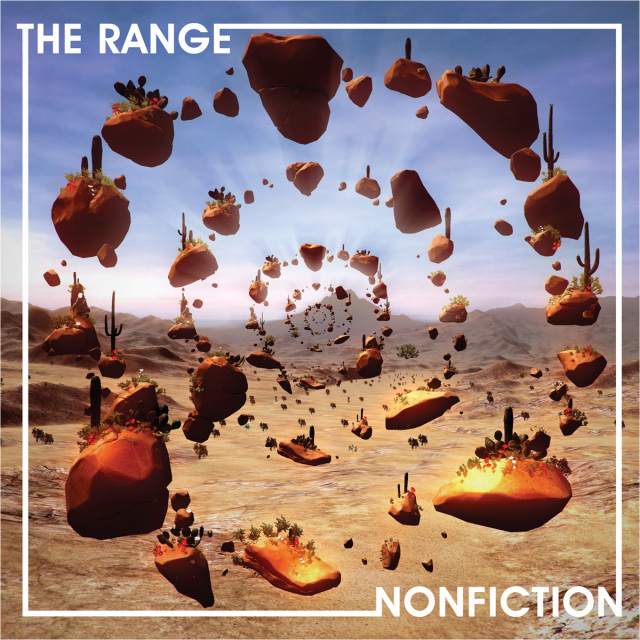
Nonfiction is an interesting title to give to a work of music, and much of my time spent listening to The Range’s new LP has also been spent wondering why he has made this distinction. Because it does feel like a distinction—as if he is asserting that his music, unlike others’, is free of narrative imaginings or embellishments.
I have always operated under the assumption that music is a form of expression that is in many ways inherently nonfictional. Even with artists like Tom Waits or David Bowie, whose songs often delve into character studies and fantastical impossibilities, there is a sense that at the core, the music is drawn out from the heart of the musician. That is to say, the source of the story always comes back to creativity, and naturally that creativity must borrow from the creator’s direct experience.
Now that I write this out, however, I realize that this can be said for almost any form of art. Philip Roth and Woody Allen both depicted fictional accounts of Jewish neurosis, something that they seemed to observe from the outside, but in the end, I don’t think anyone was really fooled into believing that they were talking about anyone other than themselves.
And for that matter, much “nonfiction” can betray itself when claiming the category. Think of Mike Daisey, who spent weeks spluttering in shame after it was discovered that his account of visiting the factories in China where Apple products are made was, in many ways, false. I think that in his case, there was a sense in his mind that what he was doing was not wrong, because in his opinion, it was true enough. Which may be a valid justification—after all, given the menagerie of biases that can skew one’s perception, is “pure nonfiction” even possible?
I believe The Range is trying to find that holy grail, and his approach is one that interests me. Instead of clinging to external realities and trying to push the subjective away, I feel that he is embracing it, conceding to it, working from the inside out.
Take, for example, the song “Jamie.” Here The Range uses an effect that appears frequently on this album—a faint, repeating vocal sample that functions as a sort of subliminal mantra: “And I’ve seen friends turn to enemies / The more people that surround me, the more lonely I feel.” The instrumentation, at first, supports this cynical sentiment—but as the song progresses, the mood morphs and swells into something more optimistic, a feeling that suggests bittersweet loneliness tinged with hope. Yet the iteration continues. This shift creates a sense of dissonance between the statement and the emotion behind it. At first, the voice speaking is that of a soulless misanthrope, but by the end of the song, he is simply someone searching for help, using this worn-out slogan to mask a vulnerability underneath.
I think that The Range is using this word—nonfiction—to assert that true nonfiction relies on the admission that most of the time, the facts are even hidden from the one presenting them. Often we cannot even figure out what really lies underneath the layers of emotional noise that cover the truth. The best attempt one can make at loyally portraying reality is portraying the various and confusing elements that make up what we haphazardly call reality. And the music in Nonfiction does just that.
Nonfiction is available now via Donky Pitch.