
Last weekend, a friend I hadn’t seen in months accidentally called me early in the afternoon. He apologized for the misdial, but asked if I was up for lunch to catch up anyways. Over a bowl of phở, we talked about how quickly the past few years had passed by. That same afternoon I had my first listen of Real Estate‘s third album Atlas. The New Jersey band’s music has often been characterized as nostalgic, but this time around it was hitting me particularly hard. I told him about Atlas and how the two and a half years since their last album had passed so uncomfortably quickly.
Between their self-titled debut, which was released just a couple months into my freshman year of college, and their second LP, Days, which soundtracked a nine-hour road trip I took to see the band play just a few weeks after its release, Real Estate has been a consistent force in my life since they emerged among the surf-pop revival of the late-aughts. Consistency is Real Estate’s forte; their style has only marginally changed from their lo-fi debut. Ten songs, one extended instrumental jam, and some plaintive lyrics about growing up and the problems that come along with it are integral facets of all of their songs. “That’s all the same” was one of the last lines on the closing track of Days, but that line is prefaced with a shrugging “it’s okay.”
Yet it would be a shame to dismiss Atlas just because it opens with a familiar jangly guitar and equally familiar lines about traveling (“I’m out again on my own / a reflection in the chrome”). Because while the music continues to ooze sunshine and beach sand, vocalist Martin Courtney undercuts it with brutally confessional lyrics about anxiety and losing control. It’s a striking shift in tone from past efforts, especially on “Crime,” where he sings, “I don’t wanna die / lonely and uptight,” the inflections at the beginning and end of each line feeling like someone forcing a smile through tears, a sort of bittersweet melancholy.
“How can I feel free? When all I want is to be by your side in that municipality,” was less than three short years ago on Days‘ “Municipality.” Now in 2014 it’s “I can’t come back to this neighborhood / without feeling my own age.” Real Estate have previously leaned on nostalgia to prop up their already whimsical, dream-like songs, but on Atlas there’s a serious disconnect between romanticizing the past and facing the present. It’s a revelatory self-awareness that hasn’t been present in their music before, at least not this directly. “Am I making any sense to you?” Courtney coos on the album’s first single, later on echoing the sentiment during “The Bend”: “Like I’m behind the wheel, but it won’t steer.”
Another track fronted by bassist Alex Bleeker shows up on the record’s second half in “How Might I Live,” which also doubles as the album’s most meandering and sad moment. Bleeker’s gentle twang carries a bit of country intonation with the song’s shuffle, an aw-shucks backwoods roundabout that’s become the bassist’s M.O. through his solo career and songs on Real Estate albums. “Horizon” similarly opens with a bit of an alt-country shuffle before evolving into a sunnier, psychedelic-tinged chorus thanks to some excellent drumming by Jackson Pollis. There aren’t any extended jams here a-la “All the Same” or “Suburban Beverage,” instead the band inserts bits and pieces of unfamiliar experimentation, like the lounge-like keys on “Past Lives” or the watery guitar solo on “April’s Song.”
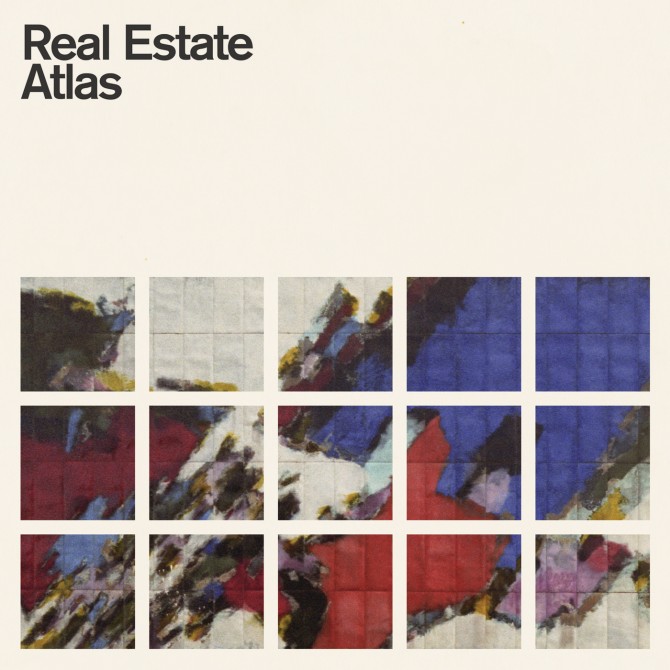
On the album’s closing track “Navigator,” Courtney sings “I have no idea where the time went.” Listening to this album for the first time, I was hit with the same uncomfortable realization: Has it really been three years since Days? Almost half a decade since Real Estate? The other day, writer Eric Harvey tweeted that he “can’t ever recall actual names” of Real Estate songs, instead referring to them as “Real Estate #23″ or something equally vague. There’s a joke somewhere in here about the increasingly beige palette the band continues to use on their album covers, mirroring the way their songs tend to bleed together. Besides being a little bit funny, it’s also a bit true for the average casual Real Estate listener: oftentimes these songs across albums can be interchangeable, emotionally and sonically.
But that minimizes the true heart of this music. Because for all of the connotations that go along with this hazy, nostalgic aesthetic, at the core Atlas is a contemplative and simultaneously comforting record. Pardon my patronizing, but art doesn’t always have to be an existentialist Kierkegaardian nightmare. Revisiting Real Estate’s catalog after Atlas reminded me of the happy memories I associate with their past albums, like that road trip through the Idaho mountains in the middle of winter. While it’s a solid thirty-eight-minute addition to their growing discography, Atlas‘ real triumph will be the warmth I feel five years from now reflecting on the good parts of my life today.
Atlas is out March 4th via Domino Records.