
Much of the music I listen to not only benefits from, but actually demands a proper context. Which can be frustrating. I love, for example, Bjork’s new record Vulnicura, a sonic wound as open and gaping as the chasm that splits the artist’s chest upon the cover. But I have to be careful in choosing when I listen to it. It is not a record I put on to “chill.” I have to be ready for, preferably yearning for, an emotionally and spiritually draining experience. And when it comes to the dark, abrasive techno that dominates much of my iTunes, my decision to play it as I run errands or make breakfast often culminates with regret and a somewhat touchy demeanor that takes an hour or two to subside. Considering that music is often compared to (or sometimes, straight up labeled as) a drug, perhaps it is best to prescribe to it, too, the considerations of “set and setting” in order to ensure an optimal experience.
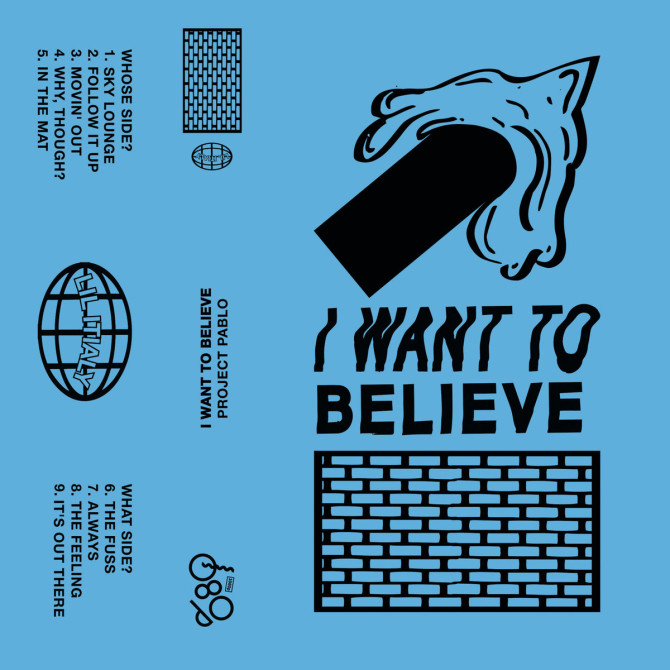
Like most people, I spend the majority of life engaging with its mundaneness. I have my share of traumatic and euphoric moments, but if I took a random sample snapshot out of my life, chances are it would come up as an image of me suppressing a fart or staring out the window. Where is the music for that? Where is the music for riding the train, buying hand cream, doing one’s taxes? This is a question that haunts me often, both in theory and in application. But the past few weeks such a dilemma has found a brief respite, thanks to Project Pablo’snew release I Want To Believe.
When I attempt to describe I Want To Believe to those I’m recommending it to, there’s usually a long moment where I hesitate to use the most obvious label for it, the one that its driving percussion and chopped up brassy samples invite, the one that its blurbs drop repeatedly and without the qualms that my pedantic, neurotic analyses create: house. This is because I don’t want others to immediately assume that Project Pablo’s music must be restrained to a site-specific experience. Of course, any of the tracks would fit delightfully into a dance-oriented DJ set, but to limit the music’s capabilities to such a small sphere would do it a disservice. What I Want To Believe has done for me, in my own boring life, is make every walk to the subway station, every forgettable day of comings and goings, a personal party. It is the music that consoles me in my least transcendent moments, that reassures me of its power to enliven my existence no matter what the context. And perhaps, in this sense, I Want To Believe is the most potent house music there is—its capacity for escapism persistent, infinite, unconditional.
The pseudo-official video for the cassette’s last song, “It’s Out There,” drives this point home. Set to a scene from the Japanese film Frog River, the track’s moody groove pulsates over images of a reclusive DJ experiencing the spiritual release of the dance floor in the privacy and solitude of his small bachelor pad-cum-basement studio, with no audience but himself—collective effervescence performed by a mere single man. It’s an act of both abnegation from and total engagement with the obstacles music can present in our attempts to enjoy it, and Project Pablo’s introvert-extrovert jams provide a truly apt score for this battle. I Want To Believe challenges us to expand our understanding of what the perfect set and setting should be, while also providing an aural aid for such an expansion in the process.
I Want To Believe is out now via 1080p.