
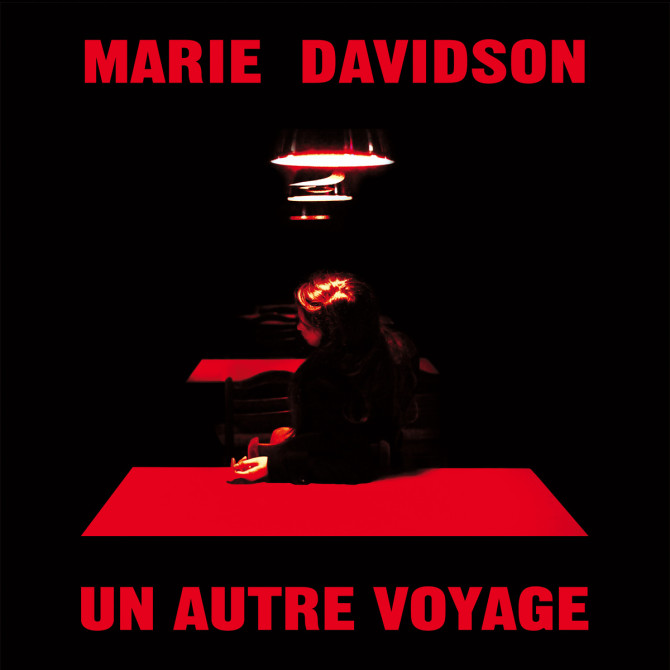
1. When Marie Davidson performs, her eyes go wide as though she is possessed. Her head thrashes forward with each beat as her hands fly at the body of knobs, buttons, faders, and keys beneath her. She is one of those performers who is quiet offstage, and when onstage becomes someone else entirely.
2. Watching her face on stage reminds me of a story about my own face: One of my old boyfriends—the very worst one of them all—once asked me to change my Facebook profile picture, a picture of me wide-eyed and grimacing as I played a spooky chord on my mandolin. He thought if his friends from back home saw it they would think I was weird. If you are a woman, there is always a chance someone will remind you that you are supposed to smile and look pretty the moment you deviate.
3. Marie conceptualized Un Autre Voyage (“another voyage”) as she was coursing through highways, cities, and towns. She’s only lived permanently in Quebec, and when we met last year in Austin, she told me she was tired but wanted to keep touring for as long as she could. So she did.
4. Music may be the art form most conducive to possession. It has always been in the business of letting the body move—or making it. We often conceptualize music as something that enters us, courses through us, changes our thoughts and behavior.
5. Un Autre Voyage is even more unabashedly sinister than her previous work. Lyrically and spiritually, this is an album of shadow and flame, sleeplessness and namelessness. The synths, from the thumping, motorik percussion to the twinkling flourishes, sound like they’re echoing inside a dark cave. She lets your hear the hiss in her breath as she sings the title words to “Exces de Vitesse” and adds it as an ominous texture to the sprawling entirety of “Kidnap You In The Desert.”
6. “Balade aux USA” propels forward over crackling percussion and bubbling sequencers as she murmurs a story of men who meet other men for surreptitious sexual encounters on the sides of highways. At the end of the song, she talks about moving to a new country where no one cares about talking to you, about changing your name. In the video, she glares into the camera, writhes against a black background with red lines, drinks champagne in what looks like a motel bathroom. In its last second she is wearing lingerie, and the grotesque white mask of some demon form covers her head entirely.
7. Benevolent spirits aren’t the kind that possess us. They seem to be able to do their work from outside of our bodies, emerging from sunlit clouds, whispering in our ears. It’s the demons who want to slip inside our skin.
8. When I imagine a person possessed, I think of a woman—Linda Blair in The Exorcist, all the women in its many imitations. A Google image search of “possession movies” shows me almost all pictures of women, their bodies contorted, their faces mangled, their eyes white. It’s more frightening to see a woman in this state because it’s more surprising. It’s the opposite of how we’re supposed to look.
9. In the background of “Boulevard Teschereau,” a synthesizer emits a glowing sound that is airy and comforting at one moment, then foreboding as the layers of melody shift into minor. She sings, “The nature of man is to let violence win over reason,” and also, repeatedly, “We are all burning.”
10. “Perséphone” is her version of the myth of Persephone, the daughter of Zeus and Demeter kidnapped by Hades and dragged to the underworld. Her longtime partner and collaborator Pierre Guerineau narrates in his low, smooth French as Marie plays the role of Persephone. He describes her calmness in the flames. As she descends into the crust of the earth amid eerie screeches of organ, she seizes her agency: “I want to go deeper,” she says. In the myth, Persephone becomes queen of the inferno.
Un Autre Voyage is out now via Holodeck Records.