
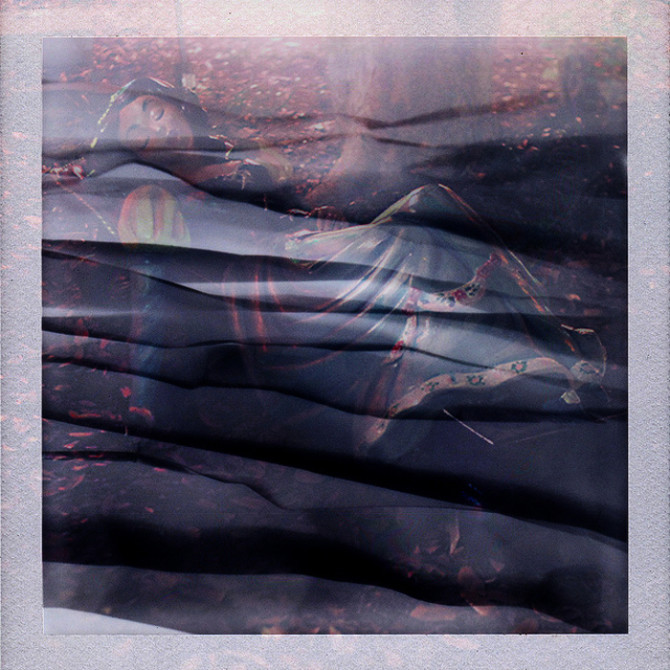
Every word, every image, and certainly every sound in Recycle Culture’s repertoire seems carefully selected. His newest release, a four-track package of originals entitled Trapped Goddess, opens with “Dreams Fade To Life,” a timestretched ambient piece that features the repeated and overlapping calls of some ethereal female figure, the kind of sound you might imagine would come from a small angel captured, like a firefly, inside a mason jar. The last two song titles, “Love Will Always Win” and “Words Just Get in The Way” read like small mission statements for the music contained within, and indeed, the music within reflects the titles with mirror-like clarity, its warm, gentle joy a palpable, peaceful weapon against negativity, carrying along vocal samples whose words seem to provide a medium for sound, reversing the argument of most fundamental linguistic theory. Even the name of Erik Moline’s project feels uncannily perfect, redefining, almost poeticizing the notion of the sample-based music with which he engages. The liner notes for Trapped Goddess are made up of only four words: “Composed by Erik M.” It appears a simple statement, but at the same time, weighty. “Produced” would be the more obvious choice, but like everything else about Recycle Culture’s work, Moline strives for the utmost accuracy in his presentation.
In many ways, I find my feelings about Trapped Goddess intersecting with the ones I wrote about just weeks earlier, when I reflected on Ricky Eat Acid’s Mixtape 1. Both artists elevate a popular musical craft to a tier that hovers above the ordinary fare, and for both artists, this tier relies on their role as the auteur, someone with a singular and consistent vision for what they are trying to achieve. This is why “composer” feels a much more apt label for Moline than “producer” ever could. This is a short album, not even half an hour long, and yet it contains movements even within each individual track, long spaces of suspended breathing room guided by emotive piano arrangements, then interrupted again by percussion that feels not like filler, but rather, the necessary next step forward. There is a perfect balance between form and content on Trapped Goddess, and this equilibrium is the key to Recycle Culture’s ability to present his work as a capital W “Work,” something not frivolous, nor ephemeral, but permanent and whole.
In an interview last year, house musician Theo Parrish said that “SoundCloud is the equivalent of a sonic selfie.” To be fair, this is an aphorism that even I, as a frequent SoundCloud visitor and owner of my own account, cannot get out of my mind, in the same way that Jonathan Franzen’s fears about social media tend to stick in my head, despite their mustiness. But I think an artist like Recycle Culture proves that the situation is not quite so simple. His presence on that contentious website is heavy, filled with remixes and reposts to boot, but the way he engages with it all is completely void of the triviality that Parrish infers in his accusation. There is a way to strike a balance between the modern and the traditional musician’s role, thank God—a way to use the tools of internet-friendly pastiche to create not a sonic selfie, but rather, as Moline does with his Recycle Culture project, something more nuanced, more sophisticated, than an older generation may think possible. A sonic selfie is one thing, but Trapped Goddess and the work that surrounds it, suggests that perhaps the way forward looks more like a sonic self-portrait.
Trapped Goddess is out now via Recycle Culture’s Bandcamp page.